My oldest (adult) child sent this message today:
I’ve been watching American Horror Story and it’s actually mostly sad. Like once you get past the creepy veneer, the episodes are like:
- hospital luring the poor with the promise of free cancer treatment and then doing crazy experiments on them
- your online bff is a cyber bully
- supermodel on ozempic decides she isn’t skinny enough and dies
And honestly yeah those are some very American problems.
And that got me thinking…
Quite lot of horror is exactly that, as it turns out.
- Frankenstein (the book) reflected the unease with the newly increasing (and unchecked) powers of scientific study and experimentation
- Godzilla was the Japanese public trying to digest the aftermath of the Bombs
- Aliens in the 60s == more science fear, man, plus holy-shit-other-countries-are-strong-now”
- “R*pe revenge” films in the 70s == fear both from and by feminism gaining power
- Various mutation films in the 80s == chemical / environmental fears
And so on, and on.
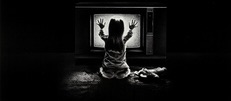
Case study: Poltergeist
I only realized recently that the original Poltergeist is a story about alcoholism’s horrible effects on middle class families.
Think about it:
- The youngest kid is the first to notice that something is different. (Sensitive little Carol Anne is the canary in this particular coal mine. )
- Something small changes, and at first it doesn’t seem like anything. In fact, Diane (the mom) actually thinks it’s kind of fun at first! (Picture Carol Anne sliding across the dining room floor.)
- Then things start to get worse – the changes start to become disruptive, even destructive – and the household starts to get scared. (“A glass of milk spontaneously breaks, silverware bends, and furniture moves on its own.”)
- After that, the strangeness actually hurts one child, and vanishes another child. (Middle child Robbie is the first, pulled out of the window by the gnarled tree. And Carol Anne is vanished into the closet.)
- The family is desperate, the house is in shambles. They reach out for help from the scientific community. The team observes and tries to help, but in the end can only diagnose the problem.
- And who ends up helping in the end? A wise, spiritual person. (“This house is clean.” They rescue Carol Anne and save the household, or so we think.)
- The spiritualist goes away, and everything is back to normal. Except all of a sudden, everything crashes down into violence and chaos, and the entire house is destroyed. (Diane is attacked, the kids are threatened with vanishment again, and they all barely escape with their lives while the house is sucked into the ground.)
If you’re still not seeing it, here are my thoughts in a more explicit form:
- Young kids are often the first to see / sense that something is wrong. They haven’t yet learned to ignore their gut, like adults have.
- Early signs of alcoholism are easy to miss, man. The everyday person isn’t trained to see this, and in any case, it’s hard to see symptoms in the person you’re closest to. Note, too, that it’s Diane who notices what Carol Anne sees, and the two of them show Steve, who is dumbfounded. (Of course the alcoholic will have an even harder time parsing what’s happening.)
- Disruptive, destructive, and in response, fear. Tell me that’s not the path of a worsening alcoholic with a family.
- The parallel of hurting Robbie is easy to grasp. But what about Carol Anne vanishing? Whether intentional or not, this is an excellent parallel for the way a child is “lost” – withdrawn, traumatized, isolated – when they are witness to or a victim of abuse.
- Science fails the family. This can be reflective of truth – after all, the 12 steps have “higher power” in there for a reason, i.e., because we humans need more than facts in order to change our behavior. Or, it can be indicative of the zeitgeist: we have always feared progress, and longed for the comfort of a greater power that will save us.
- And here comes the spiritualist! The wise woman with ties to the greater unknown, who will guide us and help save us, or help us save ourselves. (“Come toward the light! All are welcome, all are welcome!”). The message is clear to me, now: God, or spirit, or your higher Self, is what must guide you to sobriety.
- As for the very last chapter, when the spirits raise up and wreak holy hell on the household: you can choose your own meaning, of course. Maybe it’s just that thing we do, of “This is a horror film. We need the ghoulie to reach out and grab the protagonist one more time!” Or, consider that it is representative of an all-destroying relapse.
- Bonus note: the oldest child, 16-year-old Dana, is barely present for the movie. Teens are frequently seldom seen at home anyway, but I’d hazard that a teen with a chaotic household would be away far, far more than normal. Dana shows up in the last act, just in time to scream “What’s happening??”, and get pulled into the escaping car.
Somehow, the movie is even darker through this lens.
But this is one of the primary ways we process our fears as a collective: storytelling.
As it has always been, as it shall ever be.
-J